
Containerized data centerTechnical pages
Process, factory test and service
The module is engineered once and built as many times as the programme needs. Before it ships it runs under a load bank in our plant, and the suppression system is tested in the room it protects.
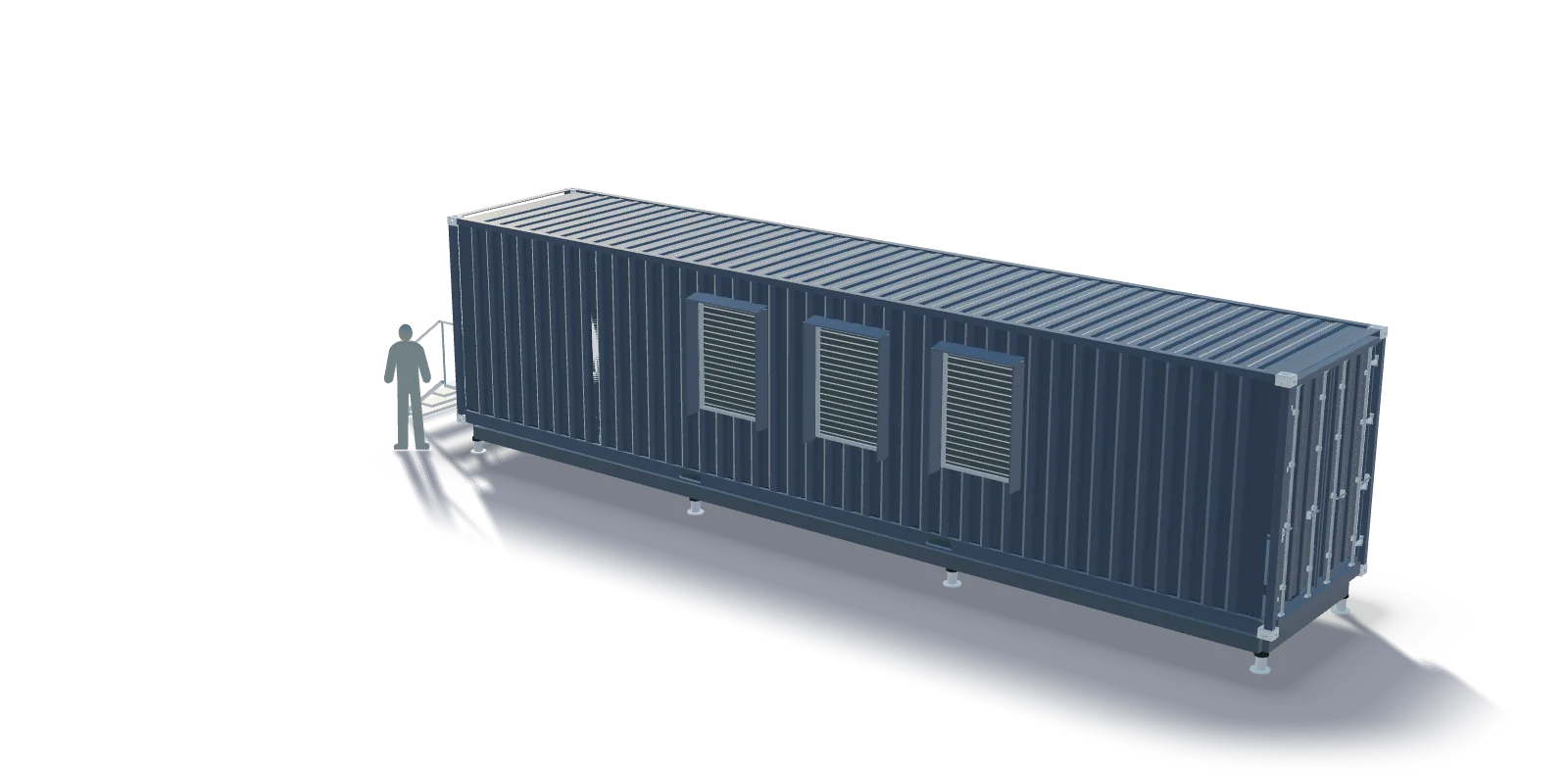
Engineering
The layout is drawn around the customer's racks: count, width, depth and density set the room, the power architecture and the cooling. One repeatable design is what makes multi-module scaling possible.
Build
The steel, the envelope, the raised base and the floor are built in our hall: robotic welding, Sa 2.5 blasting, our own paint shop. Power, cooling, suppression and monitoring are integrated in the same hall with the technology partner.
Factory acceptance test
A factory acceptance test in our plant including a load-bank test, and the integrity test of the suppression system. The customer witnesses the test; the module ships with the protocols.
Documentation
CE documentation with the module, the test protocols, the as-built drawings of the penetrations and the operating documentation.
Delivery and commissioning
An ISO module travels as a standard container; a wide-body module as special transport. On site it is set on its pad, levelled on its feet, connected and commissioned.
Warranty and service
24 months on key systems, extendable to 5 years, with scheduled inspections.
Specification sheet
| Process and service | |
|---|---|
| Testing | Factory acceptance test in our plant including a load-bank test; integrity test of the suppression system; CE documentation |
| Warranty and service | 24 months on key systems, extendable to 5 years; scheduled inspections |
Figures are the published specification of the product family, not of a customer's design. Values marked per project are set in the engineering phase.
The specification sheet is generated from the same data as this page. It is sent with the reply to your enquiry and offered for download when the form is submitted.
Request the specification sheet (PDF)FAQ
Questions procurement asks
What does the load-bank test prove?
That the power chain, the cooling and the monitoring behave under the design load before the module leaves the plant, not after the IT is installed.
Who installs the IT?
The racks and the IT are the customer's or the integrator's. The module arrives commissioned with the power, the cooling, the suppression and the monitoring tested.
How long is the warranty?
24 months on key systems, extendable to 5 years, with scheduled inspections.
Send the rack layout. The module is engineered around it.
Rack count, width, depth and the density per rack set the room, the power architecture and the cooling. The specification sheet comes with the reply.
Related
Technical pages of this solution
- Data CentersFactory-built data center modules for edge, enterprise and AI.
- Envelope and securityThe envelope is what the IT never notices: fire from outside held for 60 minutes, a burglar held at RC3, salt air held for decades, and a floor that carries the racks and keeps a leak inside.
- PowerThe technical room holds the power chain: the incoming supply, the architecture from single path to 2N, the conversion to -48 V DC and 230 V AC, the batteries and the distribution to every rack.
- CoolingAir-cooled at 5 to 10 kW per rack as the typical design point, with the aisle contained and the room kept tight. Higher density and liquid cooling are engineered on request.
- Fire and monitoringClean-agent suppression in a room that is tested to hold it, detection that sees smoke before it is smoke, and a monitoring layer that reports every sensor over SNMP and Modbus.
Related sectors