Solutions · family
Generator & Distribution
Containerised power generation, distribution and fuel: a camp-scale electrical system in ISO frames.
- 4 × 250 kW = 1 MW
- ≤ 65 dB(A) at 7 m
- 37 outlets per PDU
- 24-25 m³ fuel
Power for a deployed site, built as ISO containers so it travels the way everything else travels. Sound-attenuated generator modules, a power distribution container that synchronises them and manages load, secondary distribution units out to the loads, and a double-skinned multi-fuel tank container that keeps them running. Tanax builds the enclosures, integrates the plant and delivers the system with its documentation.
In 3D
The unit beside a person
Drawn from the published millimetres of record TC-ISO-20-DV, to scale beside a person. Drag to turn it.
Drag to turn, arrow keys to rotate
No finish is published for this unit. Shown in neutral steel.
The openings and fittings are the ones the specification describes. Their positions are representative and carry no dimension.
Specification
Generator module
- Output
- 250 kW per unit, 4 units = 1,000 kW installed
- Engine
- diesel, 4-stroke, turbocharged and intercooled, 1,500 rpm
- Fuel
- multi-fuel: commercial diesel plus F-54 / F-63 / F-65
- Alternator
- class H (180 °C), IP-22, continuous S1, class G2 AVR with permanent magnets
- Noise
- ≤ 65 dB(A) at 7 m at 100 % load
- Acoustic treatment
- 100 mm mineral wool, absorption coefficient α > 0.9, super-silent exhaust
- Cold start
- −30 °C with block preheat within 30 minutes
- Parallel operation
- 1 to 4 units, CAN-bus load sharing
- Outlets
- 20 connectors: 3 × 125 A, 3 × 63 A, 10 × 32 A, 2 × Schuko, 2 × CEE 7/3
- Tare
- max 4,500 kg, gross 16,000 kg
- Monitoring
- rugged notebook per unit, MIL-STD-810H, IP-65
- Alarms
- UHF remote alarm, 1 transmitter + 2 receivers, 1 km range; intrusion alarm EN 50131-1 grade 2, environmental class III
PDU container
- Outlets
- 5 × 125 A, 10 × 63 A, 10 × 32 A, 10 × 16 A, 2 × Schuko = 37
- Sources
- up to 4 generators plus one mains input
- Protection
- RCCB type B on every circuit, MCB per circuit, SPD type 1+2
- Control
- PLC load management, load shedding by priority, HMI ≥ 10", datalogger ≥ 1 year
- Interior
- ESD flooring, non-combustible lining, environmental control and 25 kW heating
- Spare capacity
- min. 20 % spare connectors of every type carried in the box
SDU
- Rating
- IP-65 galvanised, operable in 0.3 m flood, palletised for transport
- Quantity logic
- typically 20 units, two types, across a camp
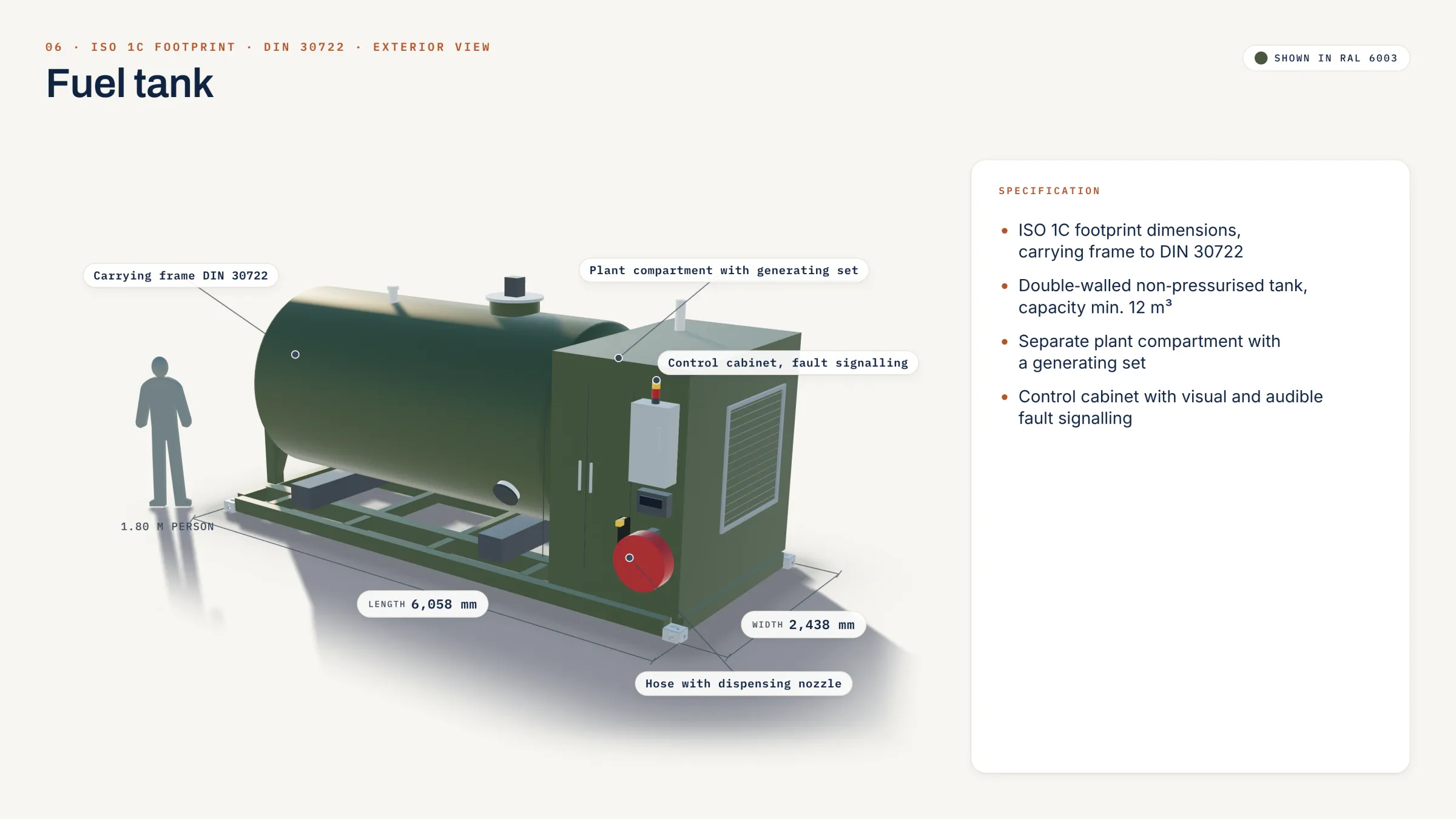
Fuel container
- Capacity
- 24-25 m³
- Frame
- full ISO 1C per ISO 1496-3:2019, tare max 4,000 kg, gross max 31,000 kg
- Tank
- double-skinned ASTM A240 316/316L stainless with interstitial leak alarm
- Fuel
- multi-fuel F-54 / F-63 / F-65
- Pump
- diesel-driven, 25 m³/h at 1 m head, 4 m suction, IP-67, ATEX
- Distribution
- 4 independent outlets, one per generator container
- Access
- walkway, ladder, 3 cross walkways with folding handrails
- Classification
- UN portable tank code T4, ADR class 3
Specification
Generator module
- Output
- 250 kW per unit, 4 units = 1,000 kW installed
- Engine
- diesel, 4-stroke, turbocharged and intercooled, 1,500 rpm
- Fuel
- multi-fuel: commercial diesel plus F-54 / F-63 / F-65
- Alternator
- class H (180 °C), IP-22, continuous S1, class G2 AVR with permanent magnets
- Noise
- ≤ 65 dB(A) at 7 m at 100 % load
- Acoustic treatment
- 100 mm mineral wool, absorption coefficient α > 0.9, super-silent exhaust
- Cold start
- −30 °C with block preheat within 30 minutes
- Parallel operation
- 1 to 4 units, CAN-bus load sharing
- Outlets
- 20 connectors: 3 × 125 A, 3 × 63 A, 10 × 32 A, 2 × Schuko, 2 × CEE 7/3
- Tare
- max 4,500 kg, gross 16,000 kg
- Monitoring
- rugged notebook per unit, MIL-STD-810H, IP-65
- Alarms
- UHF remote alarm, 1 transmitter + 2 receivers, 1 km range; intrusion alarm EN 50131-1 grade 2, environmental class III
PDU container
- Outlets
- 5 × 125 A, 10 × 63 A, 10 × 32 A, 10 × 16 A, 2 × Schuko = 37
- Sources
- up to 4 generators plus one mains input
- Protection
- RCCB type B on every circuit, MCB per circuit, SPD type 1+2
- Control
- PLC load management, load shedding by priority, HMI ≥ 10", datalogger ≥ 1 year
- Interior
- ESD flooring, non-combustible lining, environmental control and 25 kW heating
- Spare capacity
- min. 20 % spare connectors of every type carried in the box
SDU
- Rating
- IP-65 galvanised, operable in 0.3 m flood, palletised for transport
- Quantity logic
- typically 20 units, two types, across a camp
Fuel container
- Capacity
- 24-25 m³
- Frame
- full ISO 1C per ISO 1496-3:2019, tare max 4,000 kg, gross max 31,000 kg
- Tank
- double-skinned ASTM A240 316/316L stainless with interstitial leak alarm
- Fuel
- multi-fuel F-54 / F-63 / F-65
- Pump
- diesel-driven, 25 m³/h at 1 m head, 4 m suction, IP-67, ATEX
- Distribution
- 4 independent outlets, one per generator container
- Access
- walkway, ladder, 3 cross walkways with folding handrails
- Classification
- UN portable tank code T4, ADR class 3
How it is built
The decisions behind the numbers
These containers have been specified and priced in full, but not yet built. This page carries its weight on the numbers and the tables; the photographs show the electrical and service details of modules from other Tanax lines.
Noise is measured at 7 m, and that is the hard part.
≤ 65 dB(A) at 7 metres at full load is a different problem from the 75 dB(A) at 1 metre that generator datasheets usually quote. Getting there needs 100 mm of mineral wool with an absorption coefficient above 0.9, a labyrinth intake and exhaust with attenuators, and a super-silent exhaust silencer, inside an ISO 1C envelope that still has to weigh under 4,500 kg empty.
Four generators behave as one machine.
CAN-bus load sharing, automatic synchronisation, automatic mains failure, and remote monitoring over Ethernet, SNMP and Modbus. Each unit ships with a rugged MIL-STD-810H IP-65 notebook. The PDU takes up to four generator inputs plus a mains input and switches between them automatically.
Load shedding is a specification, not a feature.
The PDU's PLC carries a priority table and sheds circuits automatically on overload, with per-circuit kWh metering and at least a year of logged data exportable over USB. Every circuit gets a type B RCCB, because inverters and battery chargers make type AC devices unreliable.
Fuel is double-skinned and diesel-pumped for a reason.
A vacuum or inert-gas interstitial space with a leak alarm, and a diesel-driven ATEX pump rather than a 12/24 V electrical one, because the pump has to work when there is no camp power, which is exactly the moment the generators need refuelling. Four separate outlets feed four generator containers without a manifold change.
Configurations
Variants and where to find them in the catalogue
- No photograph yet
- No photograph yet
- No photograph yet
Secondary distribution unit (SDU)
- IP-65
- 0.3 m flood rated
- palletised
- two types
- No photograph yet
- No photograph yet
Cable and accessory set
- 125 A / 63 A / 32 A / 16 A H07RN-F sets
- drum, transits, earthing, lightning protection
 Visualisation
VisualisationView from outside 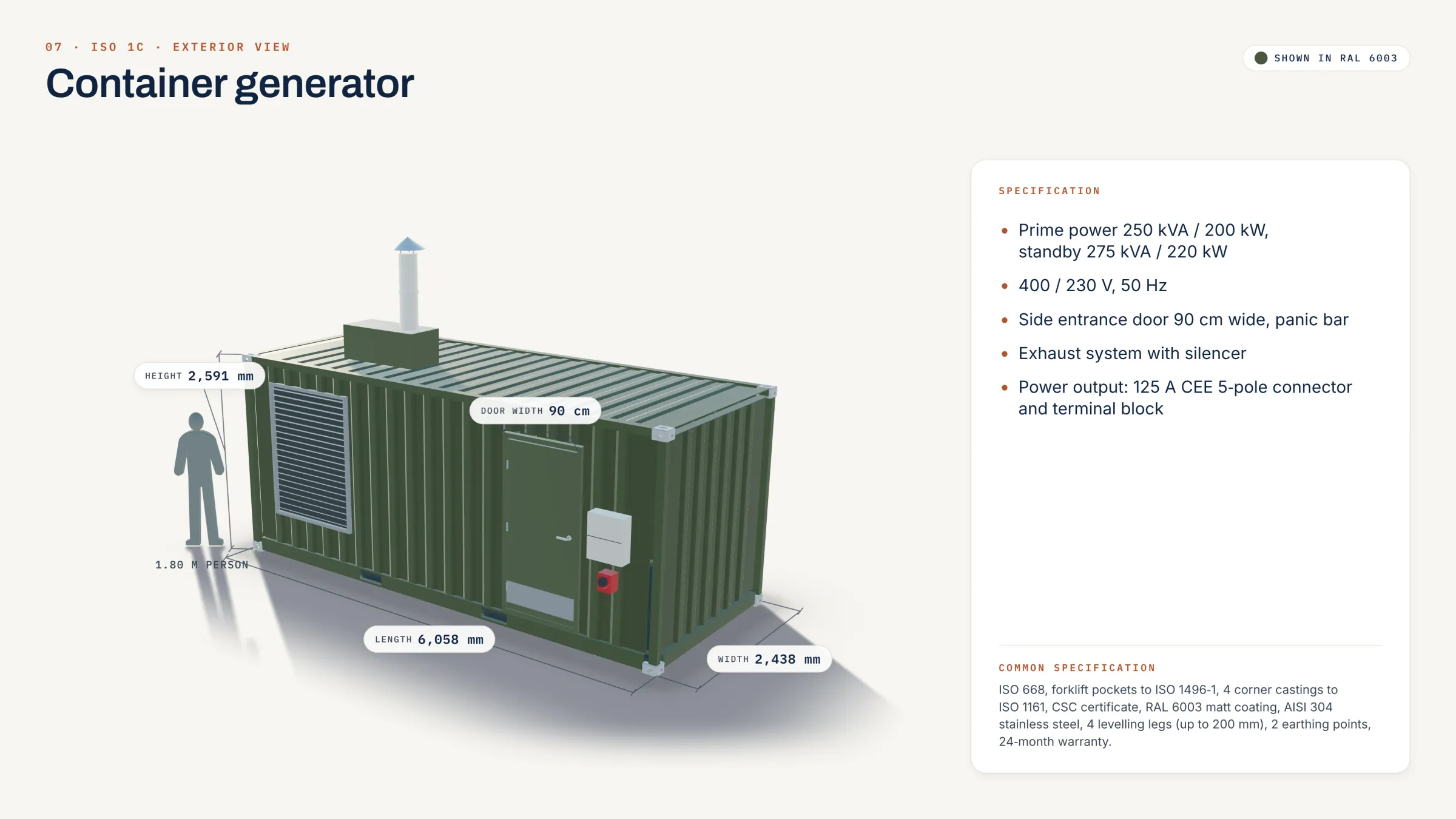 Visualisation
VisualisationView from outside 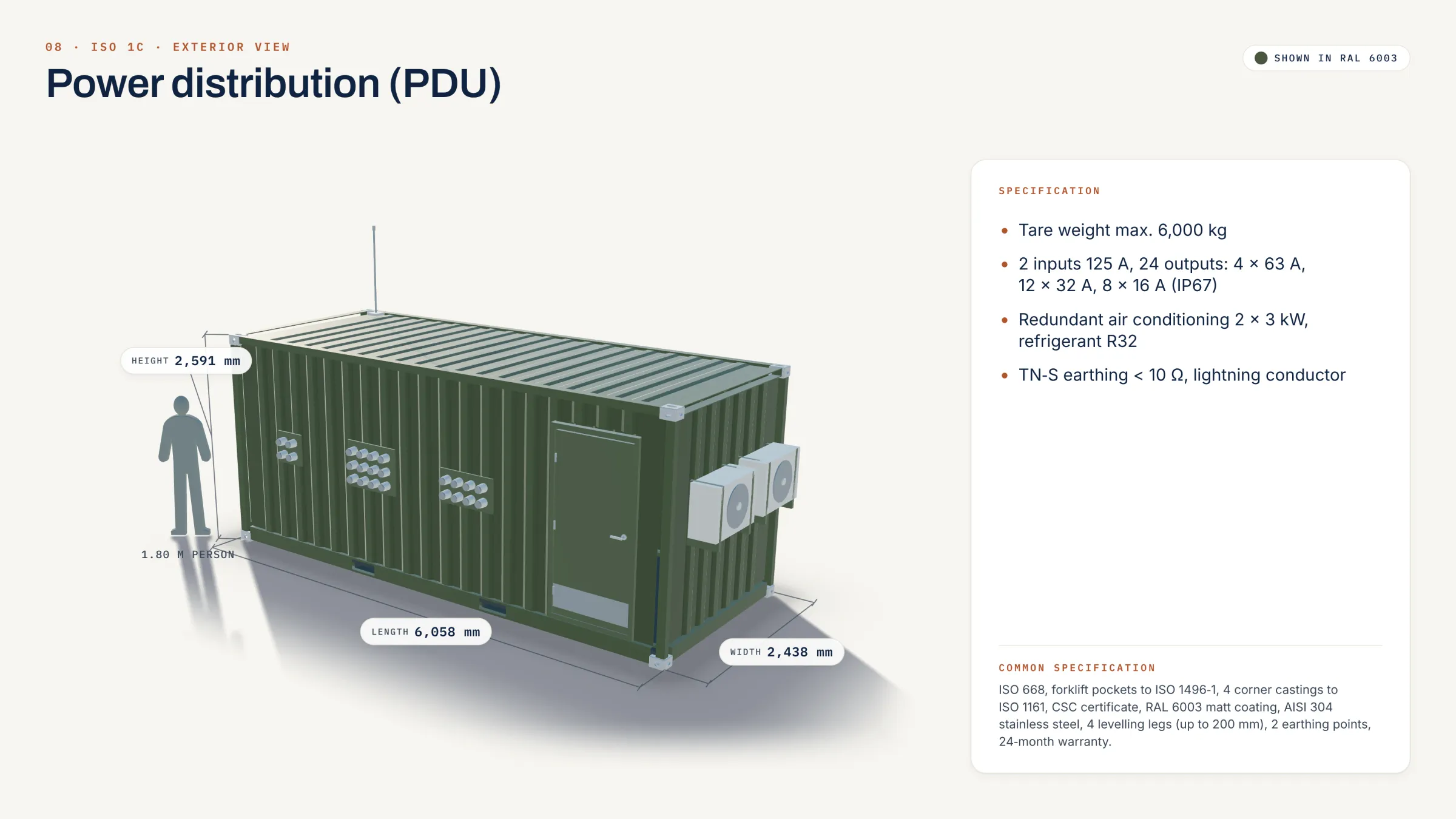 Visualisation
VisualisationView from outside
Standards
What we build to and what we issue
- EN 61439-1 / -2
- EN 60947-2
- EN 61008 / EN 61009
- EN 60309
- EN 50131-1
- ISO 1496-3:2019
- ADR 2023 class 3 / UN T4
- STANAG 7090 / 4605 / 3756
- EN 1866-1
| Standard | What it covers |
|---|---|
| EN 61439-1 / -2 | Low-voltage switchgear and controlgear assemblies |
| EN 60947-2 | Circuit breakers |
| EN 61008 / EN 61009 | Residual current devices, type B |
| EN 60309 | Industrial connectors, IP-67 |
| EN 50131-1 | Intrusion alarm systems, grade 2, environmental class III |
| ISO 1496-3:2019 | Tank container structural requirements |
| ADR 2023 class 3 / UN T4 | Dangerous goods carriage of fuel |
| STANAG 7090 / 4605 / 3756 | Multi-fuel compatibility, fuel systems, hose couplings |
| EN 1866-1 | Mobile fire extinguishers |
Documentation issued
Electrical schematics and as-built, factory test protocol including noise measurement at 7 m, load-management configuration, tank certification and leak-test record, ADR documentation, spare-parts list, SK and EN operating manuals, train-the-trainer package.
Proof
Deployments with a number in them
- 01
1 MW of installed generation
Specified as four 250 kW multi-fuel containers with CAN-bus parallel operation, for a deployable camp.
Read the case study - 02
37 output circuits per PDU
With per-circuit metering, priority load shedding and a year of datalogging, feeding 20 secondary distribution units across the camp.
Read the case study - 03
24-25 m³ of double-skinned multi-fuel storage
In an ISO 1C frame, with four outlets, one per generator container, and a diesel pump that works with the camp dark.
Read the case study
Scope
What the price includes, and what it does not
Included
- Enclosure
- Acoustic treatment
- Generating set integration
- Control and monitoring
- Output distribution
- Fuel system
- Fire protection
- Cables and accessories
- Factory testing including noise measurement
- Documentation and training
Not included
- Site earthing electrodes beyond the supplied sets
- Civil works
- Fuel
- Permanent grid connection
- Operator staffing
If we have not built exactly this before, we will say so and tell you what we have built that is closest. Two prototype programmes in this factory were delivered below cost because nobody said that early enough. We do not do that any more, to you or to us.
Lead times
By variant
| Variant | Lead time |
|---|---|
| PDU container | 16-20 weeks |
| 250 kW generator container | 20-26 weeks, driven by the generating set |
| Fuel tank container | 18-24 weeks including certification |
| SDU units | 8-12 weeks |
Engagement
Four ways to buy
Buy a catalogue unit
Pick from 94 published SKUs with full specifications, get a price, get a delivery date.
Modify a catalogue unit
Start from a standard shell and change what needs changing. Fastest route to a non-standard requirement.
Build to your specification
You bring the specification or the drawings, we review them, we build. Prototype and serial priced separately.
Subcontract fabrication
You are the prime, we are the hall. EN 1090-1 EXC2 capacity with AQAP 2110 assurance behind it.
Process
Specification to delivery in five steps
- 01
Send the specification.
A drawing, a tender annex, or three sentences. Whichever you have.
- 02
Review, in writing.
We tell you what is missing or contradictory before anyone quotes. 3-5 working days.
- 03
Quotation.
Bottom-up: material at purchase cost, co-operation, direct hours at a fully absorbed rate. 2-3 weeks for a complex build.
- 04
Design freeze and build.
Changes after freeze are variations, priced and agreed.
- 05
Test, document, deliver.
Factory acceptance where specified, full document pack, delivery and installation where quoted.
FAQ
Questions procurement asks
Do you build the generator or integrate it?
We build the container, the acoustics, the fuel system, the control and the distribution, and integrate a generating set from an established manufacturer. That is what keeps parts available for twenty years.
Can four units run in parallel?
Yes, 1 to 4 units on CAN-bus load sharing, synchronised through the PDU, with automatic mains failure.
Why type B RCCBs?
Because inverters, chargers and electronic loads produce DC residual currents that blind type AC and type A devices.
How is the noise figure verified?
Measured at 7 m at 100 % load during factory testing, and the measurement is in the test protocol.
What fuels?
Commercial diesel plus F-54, F-63 and F-65 multi-fuel compatibility, with the fuel system rated to match.
Send us the specification. A drawing, a tender annex, or three sentences.
You will get a written review of it inside a week, whether or not you buy anything.
Where to go next
Related families
- Military CommandCommand, control and shelter modules built to defence quality assurance, delivered as connected sets.
- AI & DC PowerBattery storage, UPS and switchgear enclosures: floors engineered for the rack mass, envelopes that do not burn.
- Data CentersPre-tested IT modules: the steel, the envelope and the provisions, engineered around your rack layout.
Related sectors
Related case studies