
Containerized data centerTechnical pages
Fire protection and monitoring of the data center module
Clean-agent suppression in a room that is tested to hold it, detection that sees smoke before it is smoke, and a monitoring layer that reports every sensor over SNMP and Modbus.
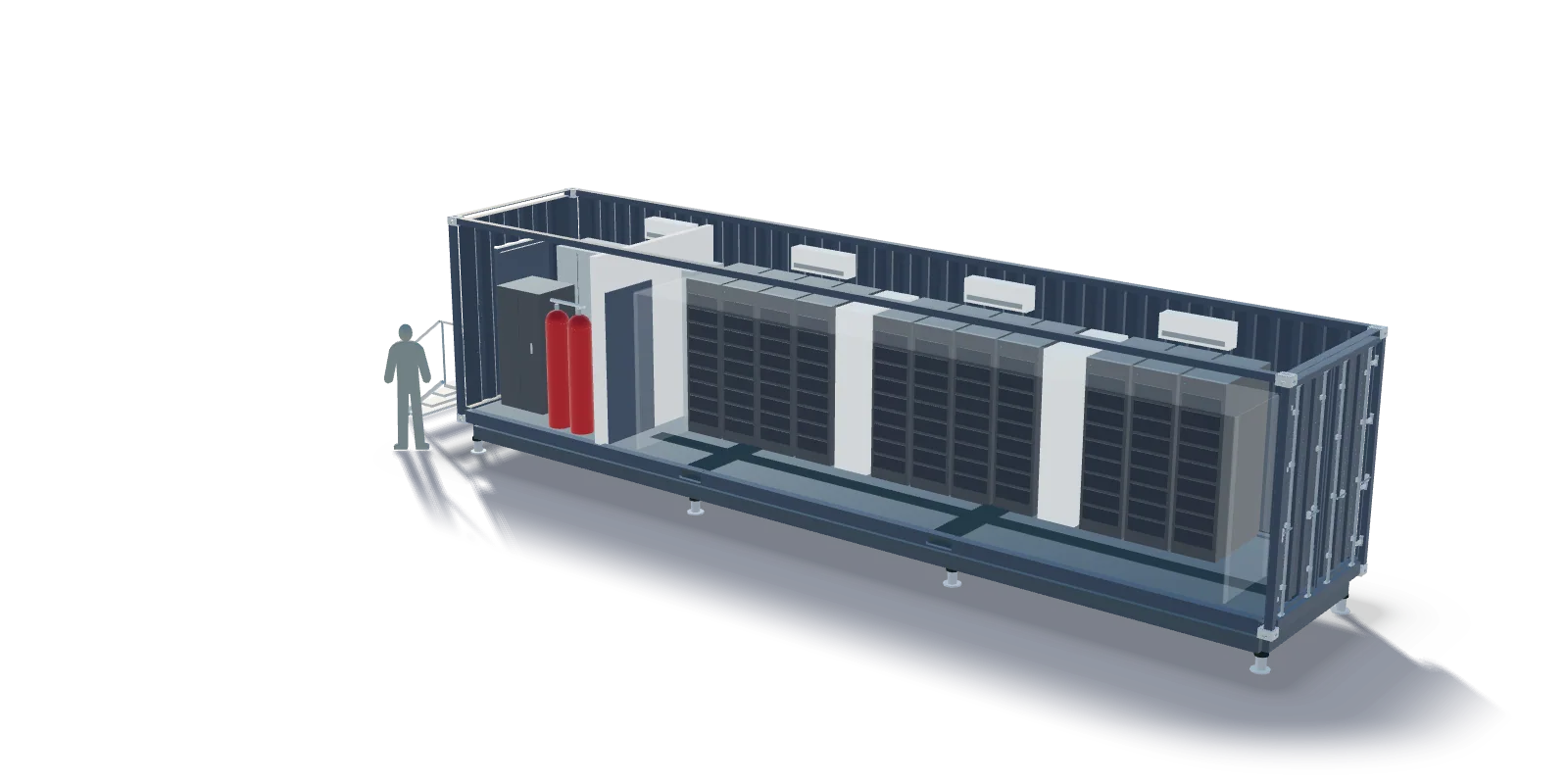
FK-5-1-12 suppression
FK-5-1-12 clean-agent gas suppression with pressure relief dampers. The cylinders stand in the technical room; the discharge is designed for the IT room's tight volume.
Detection
Aspirating smoke detection (ASD) plus point detectors, sounders, and start and stop buttons at the door. Detection is fitted to the components' standards (VdS, EN 54).
The integrity test
The enclosure integrity (door fan) test per NFPA 2001 / ISO 14520 proves the room holds the agent for the required time. It is part of the factory acceptance test.
EMS controller
An EMS controller reads temperature, humidity, pressure, smoke, water leak, PIR and hydrogen sensors, and reports over SNMP and Modbus RTU/TCP.
DCIM
A DCIM supervision layer sits on top of the EMS, so the module reports into the customer's operations like any other room.
Security
Prepared for access control, CCTV and intruder alarm, with the personnel doors ready for the access control system the site runs.
Specification sheet
| Fire and monitoring | |
|---|---|
| Fire | FK-5-1-12 clean-agent gas suppression with pressure relief dampers; aspirating smoke detection (ASD) plus point detectors; sounders, start and stop buttons; enclosure integrity (door fan) test per NFPA 2001 / ISO 14520 |
| Monitoring | EMS controller with temperature, humidity, pressure, smoke, water leak, PIR and hydrogen sensors; SNMP, Modbus RTU/TCP; DCIM supervision layer |
Figures are the published specification of the product family, not of a customer's design. Values marked per project are set in the engineering phase.
The specification sheet is generated from the same data as this page. It is sent with the reply to your enquiry and offered for download when the form is submitted.
Request the specification sheet (PDF)FAQ
Questions procurement asks
Why a clean agent?
FK-5-1-12 leaves no residue on the IT and is discharged into a room engineered to stay tight: no fresh-air system, sealed penetrations and an integrity test per NFPA 2001 / ISO 14520.
Which protocols does the monitoring speak?
SNMP and Modbus RTU/TCP from the EMS controller, with a DCIM supervision layer above it.
Why a hydrogen sensor?
Battery strings can release hydrogen under fault. The sensor is one of the EMS inputs beside temperature, humidity, pressure, smoke, water leak and PIR.
Send the rack layout. The module is engineered around it.
Rack count, width, depth and the density per rack set the room, the power architecture and the cooling. The specification sheet comes with the reply.
Related
Technical pages of this solution
- Data CentersFactory-built data center modules for edge, enterprise and AI.
- Envelope and securityThe envelope is what the IT never notices: fire from outside held for 60 minutes, a burglar held at RC3, salt air held for decades, and a floor that carries the racks and keeps a leak inside.
- PowerThe technical room holds the power chain: the incoming supply, the architecture from single path to 2N, the conversion to -48 V DC and 230 V AC, the batteries and the distribution to every rack.
- CoolingAir-cooled at 5 to 10 kW per rack as the typical design point, with the aisle contained and the room kept tight. Higher density and liquid cooling are engineered on request.
- Process and factory testThe module is engineered once and built as many times as the programme needs. Before it ships it runs under a load bank in our plant, and the suppression system is tested in the room it protects.
Related sectors