
20 ft container height: 2240 mm, 2393 mm or 2698 mm internal
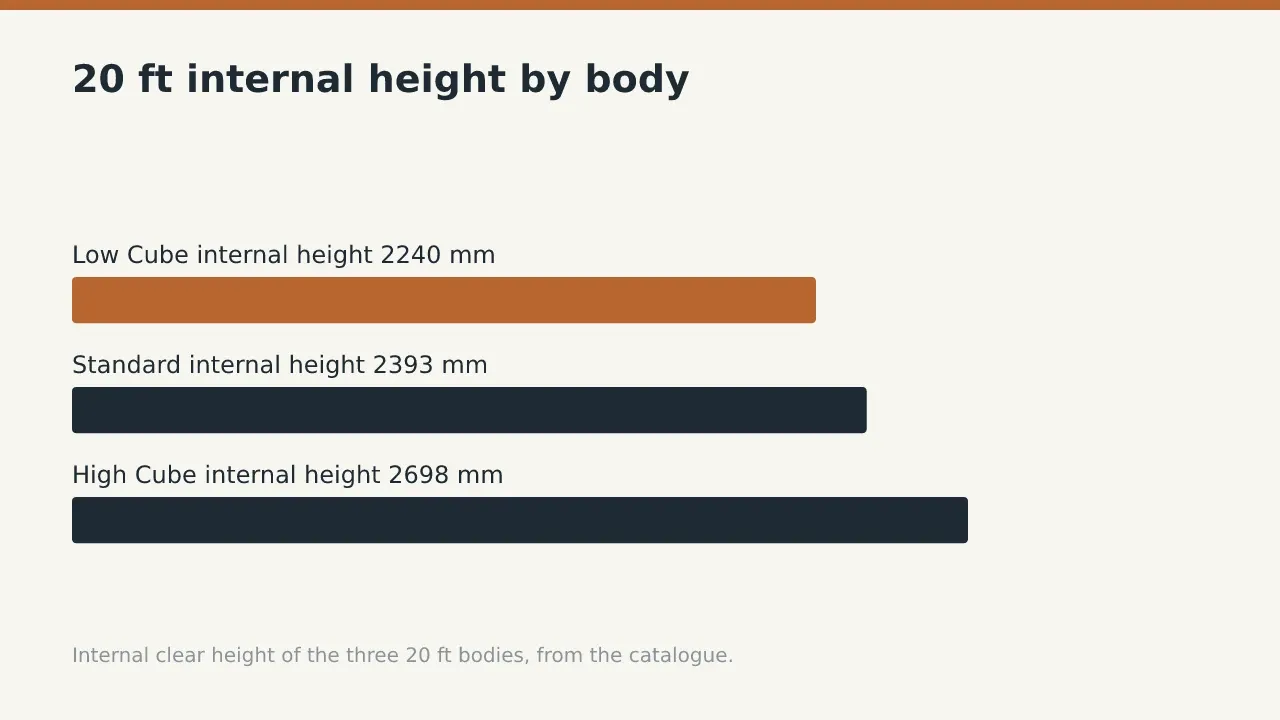
A 20 ft container comes in three body heights, and the load decides at the door which one you need. Inside, the Low Cube gives 2240 mm, the Standard 2393 mm and the High Cube 2698 mm. The door openings sit lower, at 2127 mm, 2280 mm and 2585 mm. A crate that clears the roof can still stop at the header. Measure against the door first, and the rest of the choice follows.
Compare the door before the roof
Compare the door opening first, because it is the dimension that turns a load away. The internal height matters only once the load is through and has to be stacked or lined.
| 20 ft Low Cube | 20 ft Standard | 20 ft High Cube | |
|---|---|---|---|
| Internal height | 2240 mm | 2393 mm | 2698 mm |
| Door opening height | 2127 mm | 2280 mm | 2585 mm |
| Door opening width | 2343 mm | 2343 mm | 2340 mm |
| Internal volume | 31 m3 | 33.1 m3 | 37.4 m3 |
| Tare weight | 2150 kg | 2000 kg | 2150 kg |
Three lines in that table change an order.
The door width barely moves. It is 2343 mm on the Low Cube and the Standard and 2340 mm on the High Cube. A load that clears the width of one door clears all three, so height is the only door dimension you are choosing.
The High Cube door gains the full 305 mm over the Standard, from 2280 mm to 2585 mm. A machine stopped by the Standard header often passes the High Cube header with room left for the forks.
The tare runs the other way from what most buyers expect. The Low Cube weighs 2150 kg, the same as the High Cube, and the Standard is the lightest at 2000 kg. The lower body saves nothing on the crane hook or the trailer.
Measuring a load against the three doors
Measure the load as it will travel, then hold that figure against each door opening. The smallest body whose door clears it is the one to price.
- Measure the tallest item on its pallet, with packaging and strapping, from the floor to its highest point.
- Add the lift. The forklift driver carries the pallet clear of the floor, so the forks and the pallet base pass under the header with the load.
- Hold the total against the door opening: 2127 mm on the Low Cube, 2280 mm on the Standard, 2585 mm on the High Cube. A load that only clears the internal height has to be laid down to go in.
- Level the container on firm ground before the first pallet goes in. The site manager checks the base before the crane driver sets the box down, because a body out of level twists the frame and the doors bind.
- Lift the load in, set it down, and measure the gap to the roof. That margin, taken from 2240 mm, 2393 mm or 2698 mm, decides whether a second tier fits on top.
When the Low Cube earns its place
Choose the Low Cube when the limit is outside the container rather than inside it. It stands 2438 mm tall, against 2896 mm for the High Cube.
That outside height decides whether the unit fits under a canopy, through a covered gateway or into a hall with a low door. Inside, it costs you. The interior is 2240 mm, the door 2127 mm and the volume 31 m3, the smallest of the three. Racked stock and tall equipment are the first things to stop fitting.
The 20 ft low cube dimensions run to 5898 mm long and 2350 mm wide inside, which is the floor any racking plan starts from.
Standard or High Cube for storage
For palletised storage, the Standard is usually enough. Its 2280 mm door and 2393 mm interior take most stacked goods, and at 2000 kg it is the lightest body to lift and haul.
The High Cube earns its extra 305 mm in three cases. Upright machinery goes in standing rather than laid down. A second pallet tier gets the clearance to load safely. Racking takes one more shelf. The volume rises from 33.1 m3 to 37.4 m3 on the same 20 ft footprint. If none of those cases apply, the extra height is space nobody uses.
The 20 ft high cube internal dimensions are 5898 mm long and 2352 mm wide, so only the height separates its floor plan from the Low Cube. On longer bodies the same logic holds, and the guide to standard against High Cube height follows the 305 mm through a lined interior.
Doors along the long side
When the forklift has to reach every pallet without moving the front row, the load goes in from the side. The High Cube Side Door body opens 5702 mm wide and 2494 mm high along its length. The opening costs height and weight. The interior drops to 2607 mm and the tare rises to 3250 kg, against 2698 mm and 2150 kg for the plain High Cube. Weigh that against the time saved at the door before you specify the high cube side door container for a store that turns over daily.
High Cube or a purpose built module for people
If people will work inside for a full day, start from the High Cube or skip the conversion. Insulation, a ceiling and a raised floor all take height, and the 2698 mm interior is the only one that still leaves a room.
A Standard starts at 2393 mm and loses height to every layer. The thickness you choose when comparing PIR or mineral wool insulation comes straight off that figure.
A Tanax office module is built for occupation from the start. It measures 6058 mm long, 2438 mm wide and 2800 mm high outside, with about 2500 mm of clear height inside. PIR sandwich panels and electric heating are already in. A High Cube conversion reaches a similar finished height only after its lining is fitted, so price both routes before committing. The site office and living modules list the layouts, and the office container buyer's checklist covers what to specify before the order.
What to send before you order
Send the measured load or the fit out drawing, not the body name alone. With those figures, an engineering review returns a fixed price and lead time, typically in 3 to 5 working days for standard families.
If the containers form one part of a larger site, the site facility planning sequence shows where the order sits in the programme. Catalogue units take 6 to 10 weeks from order, so the measurement belongs before the delivery date is promised to anyone.
Measure the tallest item on its pallet, add the forks, and write down whether anyone will work inside. Send those figures with the number of units and the delivery site.
FAQ
What is the internal height of a 20 ft High Cube container?
2698 mm, against 2393 mm in the 20 ft Standard and 2240 mm in the Low Cube. Its door opening is 2585 mm high.
How much does each 20 ft container hold in m3?
The Low Cube holds 31 m3, the Standard 33.1 m3 and the High Cube 37.4 m3.
Is a Low Cube lighter than a standard 20 ft container?
No. The Low Cube weighs 2150 kg, the same as the High Cube, while the Standard is the lightest at 2000 kg.
How wide is the door opening on a 20 ft High Cube?
2340 mm, against 2343 mm on the Standard and the Low Cube. The width is practically the same, so height is the deciding door dimension.
Send the measured load or the fit out drawing with a request for an offer, and the reply comes back with a fixed price and lead time.
Related guides
Kitchen and laundry containers: water tanks from 2 to 10+ m3
A kitchen or laundry container is sized from its crew: the water drawn, the heat needed and the steam made. Water tanks run from 2 to 10+ m3.
Container site facility planning: 6058 mm modules and 6 to 10 weeks
A site camp is planned from the busiest shift outward: office, sanitary and storage units on one 6058 mm grid, set on level pads and connected in order.
Custom container to your drawings: what happens in 10 to 16 weeks
A custom container takes 10 to 16 weeks at Tanax. The drawing is reviewed, priced and signed before any steel is cut, then followed through the hall to the delivery note.
Have a specification in mind?
Send it through the quote form and the engineering review returns a fixed price and lead time, typically within 3 to 5 working days.