
Special-purpose sheltersTechnical pages
EMC and EMP shielding: the chain from the weld to the measurement
A shielded shelter is only as good as its weakest aperture. The chain below is read the way a programme engineer reads it: the enclosure, every aperture, the point of entry, the grounding, and the measurement that proves it.
To scale
The shielded shelter beside a person
Drawn as a layer cutaway: the outer skin, the continuous welded shield, the insulation and the interior, with the point-of-entry panel, the honeycomb waveguide vents and the RF-gasketed door, standing on a hooklift flatrack. Switch the layers and the carrier.
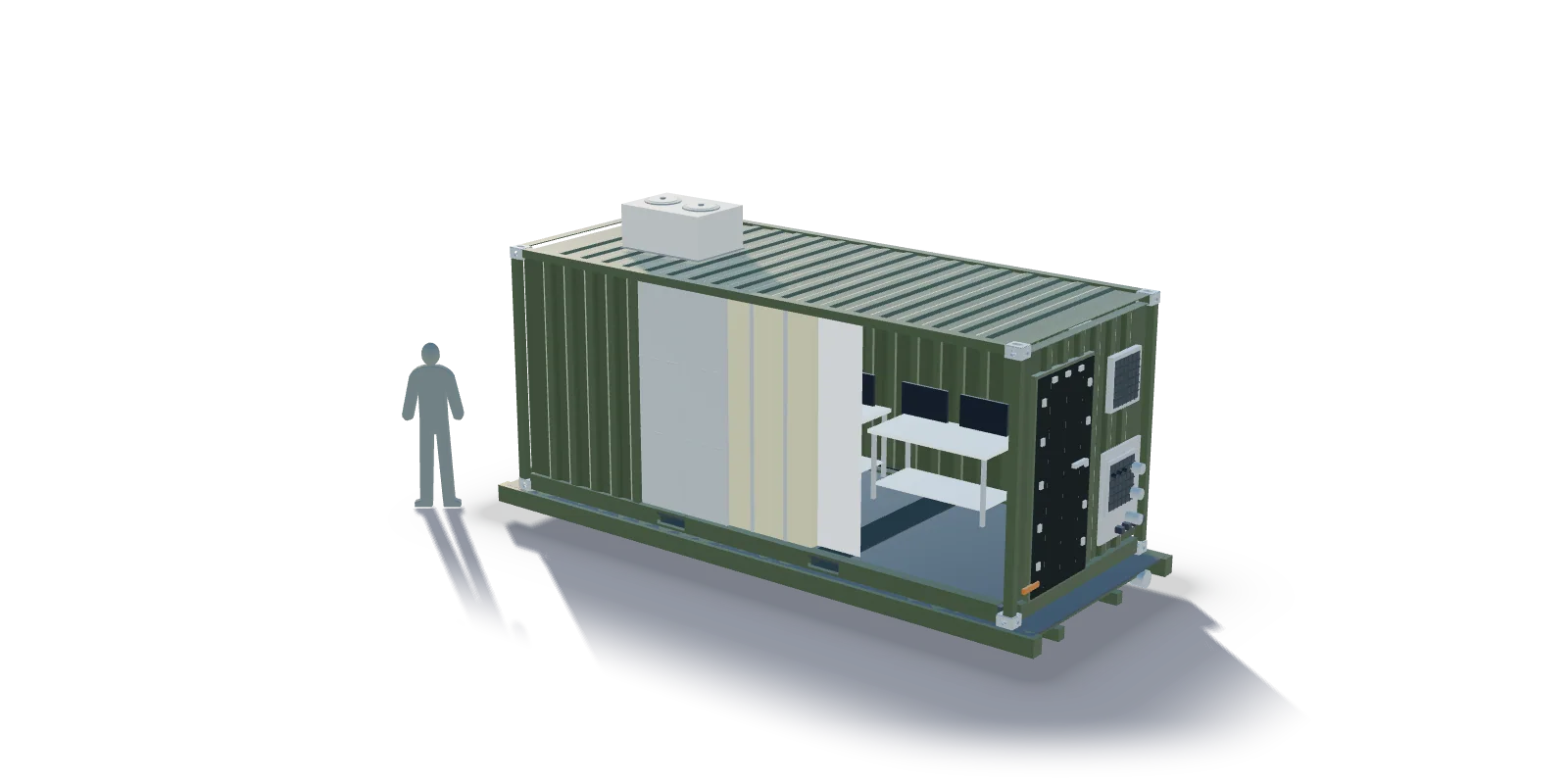
A visualisation of the design, not a photograph of a delivered unit. The ISO 20 ft frame carries its standard envelope; the layer thicknesses and the fittings are drawn proportions, never a specification. Shielding effectiveness, levels and classes are specified and measured per project.
1. The enclosure
A continuous welded steel shielded enclosure, a Faraday cage, with the seams and the surfaces designed for conductivity. The outer skin is not the shield: the shield is a welded steel layer inside the insulation, continuous across every wall, the floor and the roof, and every seam is a weld, not a joint.
2. The door
The door is the largest aperture, so it is an RF-gasketed shielded door with multi-point compression: the gasket is compressed evenly along the full perimeter by the locking points, and the frame is welded into the shield.
3. Every air path
Honeycomb waveguide vents on all air paths: the intake, the exhaust and the HVAC. A honeycomb of cells below cutoff passes the air and attenuates the field; no air path bypasses one.
4. One point of entry
Everything that crosses the shield crosses it at a single point-of-entry panel. Power enters through EMP/EMI filters and surge arresters mounted on the panel; signals enter on fibre through waveguide-below-cutoff penetrations. No copper signal line enters the shielded volume.
5. Bonding and grounding
The shield, the frame, the filters and the arresters are bonded, grounded at a single point, and the shelter carries lightning protection to IEC 62305.
6. The specification
The shielding effectiveness is specified per project: the frequency range and the attenuation the programme requires. HEMP protection is engineered to MIL-STD-188-125-2 for transportable systems; MIL-STD-461, MIL-STD-464, the EN 61000 series and NATO AECTP-500 are the references.
7. The measurement
The shielding effectiveness is measured to IEEE 299 by an accredited laboratory, per project, on the shelter as built. Tanax builds the shelter the measurement is run on; the result belongs to the programme.
Specification sheet
| EMC and EMP | |
|---|---|
| Enclosure | Continuous welded steel shielded enclosure (Faraday cage) with seam and surface design for conductivity |
| Shielding effectiveness | Specified per project and measured to IEEE 299 by an accredited lab |
| HEMP | Protection to MIL-STD-188-125-2 (transportable systems) |
| Doors | RF-gasketed shielded doors with multi-point compression |
| Vents | Honeycomb waveguide vents on all air paths |
| Point of entry | Single point-of-entry panel, power through EMP/EMI filters and surge arresters, signals on fibre through waveguide-below-cutoff penetrations |
| Grounding | Bonding, single-point grounding, lightning protection to IEC 62305 |
| References | MIL-STD-461, MIL-STD-464, EN 61000 series, NATO AECTP-500 |
Figures are the published specification of the product family, not of a customer's design. Values marked per project are set in the engineering phase.
The specification sheet is generated from the same data as this page. It is sent with the reply to your enquiry and offered for download when the form is submitted.
Request the specification sheet (PDF)FAQ
Questions procurement asks
Does Tanax hold an EMC or EMP certificate for its shelters?
No. The shielding effectiveness is specified per project and measured to IEEE 299 by an accredited laboratory on the shelter as built. Tanax engineers and builds the shelter; the measurement is the programme's.
Why fibre only?
A copper signal line through the shield is an antenna into the shielded volume. Signals enter on fibre through waveguide-below-cutoff penetrations; power enters through filters and surge arresters at the single point of entry.
Can the shelter be moved?
Yes. ISO 1496 corners with CSC, hooklift flatracks to STANAG 2413 and DIN 30722, rail transport and sling points. The shielded volume is the shelter, not the carrier.
Send the requirement. The shelter is engineered to it and measured against it.
Frequency range and attenuation, TEMPEST level and zone, protection level, climate and carrier: name them and the engineering starts. The specification sheet comes with the reply.
Related
Technical pages of this solution
- Military CommandSpecial-purpose shelters to NATO standards, built by a defence manufacturer that also builds and services military trucks.
- TEMPESTTEMPEST is the discipline of keeping an emission inside. The shelter contributes the shielded volume, the separation and the filtered services; the level and the accreditation belong to the programme and its national security authority.
- CBRN collective protectionCollective protection keeps the inside clean while the outside is not: a filtered overpressure, an airlock to pass through and seals that hold.
- Ballistic and blastArmour is a level the customer names and a laboratory verifies. Tanax brings the armoured truck cab work: the panels, the liners and the doors that take a round or a blast.
- Mobility and transportA shelter that cannot move is a building. Every Tanax shelter carries ISO 1496 corners and moves by truck, hooklift, rail or sling; air-transportable sizes and expandable shelters are engineered on request.
- Environment and signatureThe shelter is engineered for the climate it is sent to and for how little of it should be seen: in daylight, in infrared and at night.
- Armoury containersA weapon store is a security cage first and a container second. Tanax has engineered one from a written specification before; this page is the build.
Related sectors