
Special-purpose sheltersTechnical pages
CBRN collective protection
Collective protection keeps the inside clean while the outside is not: a filtered overpressure, an airlock to pass through and seals that hold.
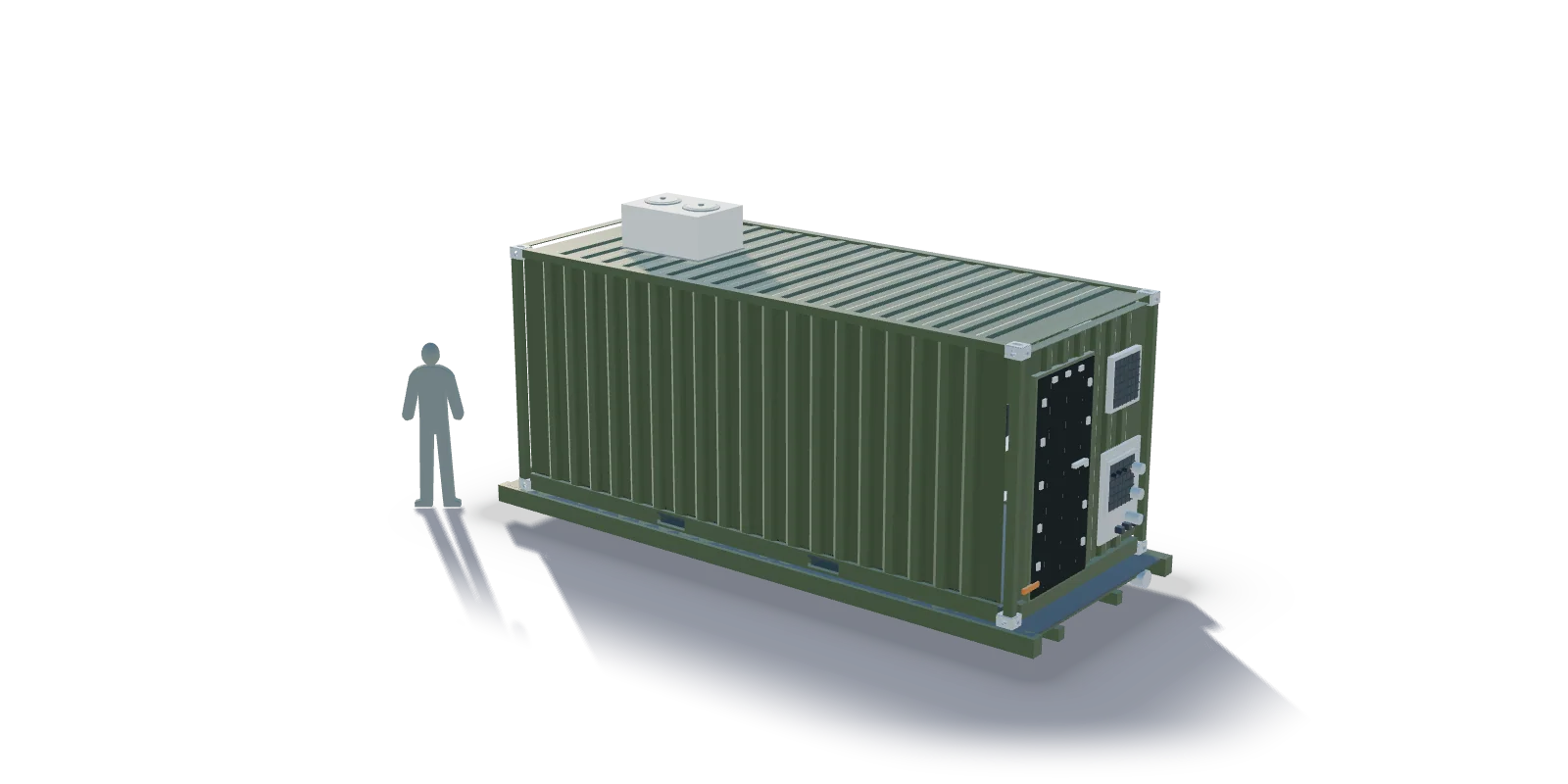
Overpressure
The shelter is held at an overpressure against the outside, so every leak path flows outwards. The HVAC with NBC filtration supplies the air that keeps the pressure.
NBC filtration
The supply air passes through NBC filtration before it enters the protected volume. The filtration unit is part of the life support beside the generator and the UPS.
Airlocks
People enter through an airlock: one door closed before the next opens, with the overpressure flushing the lock. A decontamination module adds the wash-down before the lock.
CBRN-tight seals and penetrations
Every door, every penetration and every seam is CBRN-tight. The same discipline that seals the shield seals the atmosphere.
Specification sheet
| CBRN | |
|---|---|
| Collective protection | Overpressure, NBC filtration, airlocks, CBRN-tight seals and penetrations |
| Mobility and life support | |
| Mobility | ISO 1496 corners and CSC, hooklift flatracks to STANAG 2413 and DIN 30722, rail transport, sling points, air-transportable sizes on request, expandable shelters |
| Life support | Generator, UPS, HVAC with NBC filtration, earthing |
Figures are the published specification of the product family, not of a customer's design. Values marked per project are set in the engineering phase.
The specification sheet is generated from the same data as this page. It is sent with the reply to your enquiry and offered for download when the form is submitted.
Request the specification sheet (PDF)FAQ
Questions procurement asks
Can a CBRN shelter also be shielded?
Yes. The welded enclosure, the single point of entry and the sealed penetrations serve both; the vents become filtered waveguide vents.
What runs the filtration?
The life support: generator, UPS and the HVAC with NBC filtration, with the earthing the shielded chain requires.
Send the requirement. The shelter is engineered to it and measured against it.
Frequency range and attenuation, TEMPEST level and zone, protection level, climate and carrier: name them and the engineering starts. The specification sheet comes with the reply.
Related
Technical pages of this solution
- Military CommandSpecial-purpose shelters to NATO standards, built by a defence manufacturer that also builds and services military trucks.
- EMC and EMP shieldingA shielded shelter is only as good as its weakest aperture. The chain below is read the way a programme engineer reads it: the enclosure, every aperture, the point of entry, the grounding, and the measurement that proves it.
- TEMPESTTEMPEST is the discipline of keeping an emission inside. The shelter contributes the shielded volume, the separation and the filtered services; the level and the accreditation belong to the programme and its national security authority.
- Ballistic and blastArmour is a level the customer names and a laboratory verifies. Tanax brings the armoured truck cab work: the panels, the liners and the doors that take a round or a blast.
- Mobility and transportA shelter that cannot move is a building. Every Tanax shelter carries ISO 1496 corners and moves by truck, hooklift, rail or sling; air-transportable sizes and expandable shelters are engineered on request.
- Environment and signatureThe shelter is engineered for the climate it is sent to and for how little of it should be seen: in daylight, in infrared and at night.
- Armoury containersA weapon store is a security cage first and a container second. Tanax has engineered one from a written specification before; this page is the build.
Related sectors