Deployable camp system
- 12
- module types in one system
- 1 MW
- installed generation
- 58.5 m³
- potable water
- 63 m³
- wastewater
- 300
- covers per kitchen module
The brief
A camp is not a container order. It is a system: people have to sleep, wash, eat, keep food cold, have power, have fuel for the power, have water in and water out, and have somewhere to put the spares. Tanax specified and priced the whole set, module by module, against a detailed statement of work, and then audited its own earlier pricing against that statement and corrected it.
The system
What the system contains
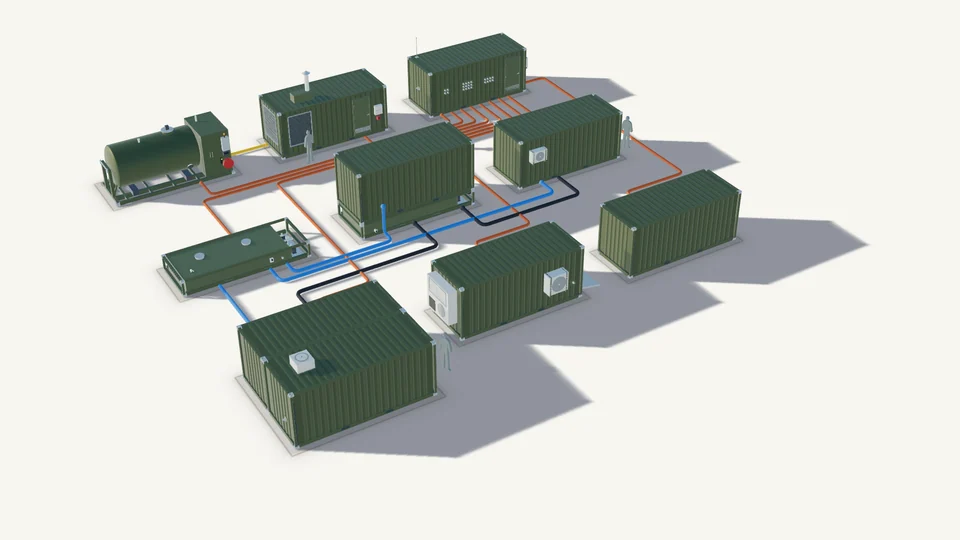
- Sanitary container
- Drinking water container
- Wastewater container
- Container laundry
- Kitchen module
- Fuel tank
- Container generator
- Power distribution
- Storage container
- Refrigerated and freezer container
- Power
- Water
- Wastewater
- Fuel
| Module | Quantity logic | Defining specification |
|---|---|---|
| Sanitary | up to 10 | ISO 1C, tare ≤ 6,500 kg, WC section (2 cubicles, 2 urinals, 2 basins, 10 L heater, hose reel) + shower section (3 showers, 2 basins, 2 hand dryers, 2 folding seats, 300 L heater, hose reel), anti-Legionella on both heaters, 32 A, 100 m cable |
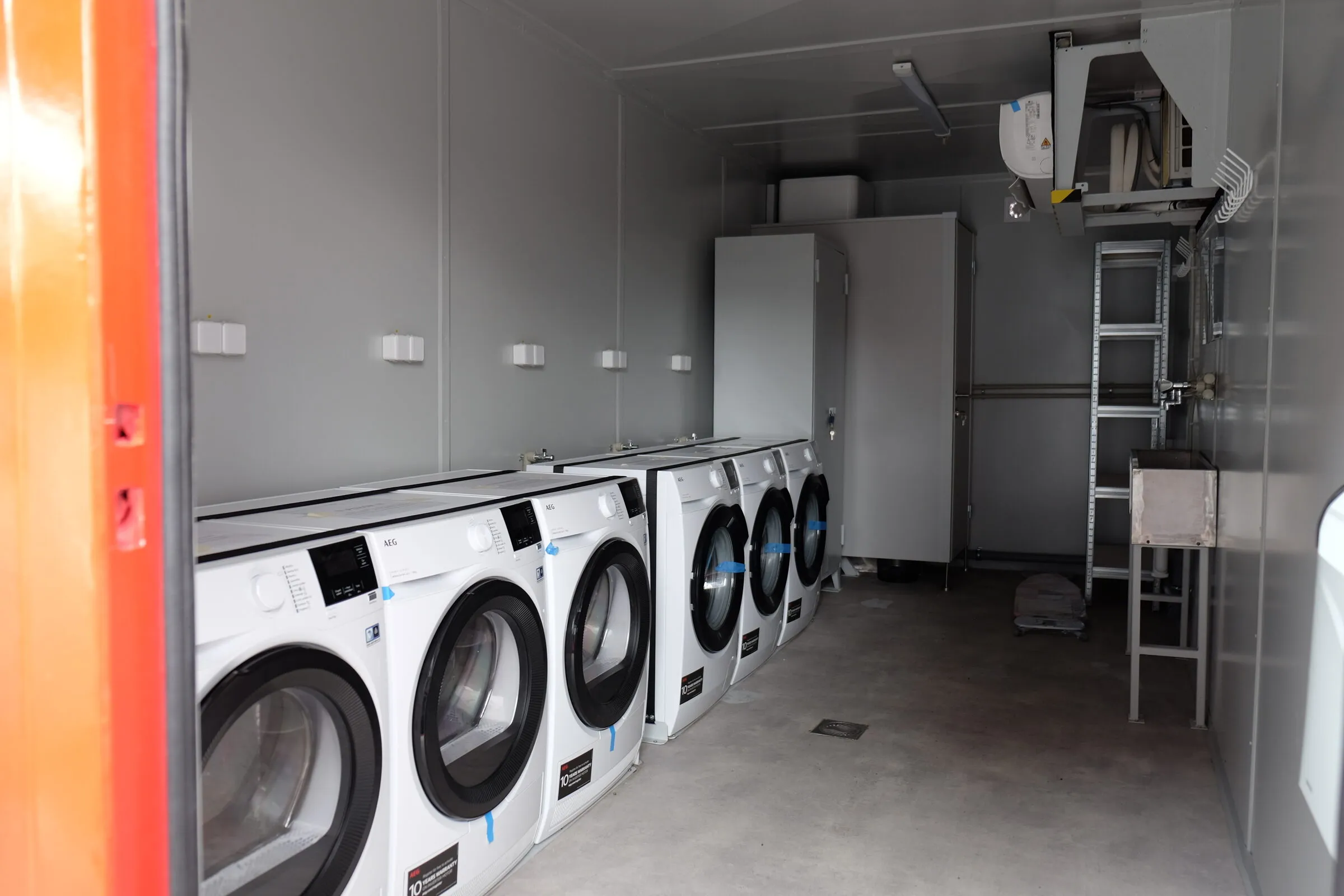
| Laundry | 1 | tare ≤ 7,500 kg, 6 × 8 kg professional washers + 6 × 8 kg dryers stacked in pairs, self-service for 6 at once, 125 A, 30 m cable, water softener mandatory, 500 lx |
| Kitchen | up to 6 sets, 2 containers each | 300 covers full menu / 900 soup and drinks, hot side + cold side joined on the long face, 20 × GN 1/1 combi oven, 4,300 L refrigeration, tunnel dishwasher at 1,100 plates/h, 125 A per container, hood suppression, 600-1,000 lx |
| Refrigerated | 1 | tare ≤ 4,500 kg, +2 to +5 °C chill and −25 to −18 °C freeze behind an adjustable partition, doors on the long side for a EUR pallet, polar PVC strip curtain, integrated multi-fuel generator with ≥ 24 h autonomy and auto-start, 24 V / 250 A vehicle-start output, entrapment alarm and internal release mandatory, shelves 350 kg each |
| Potable water | 9 | ISO 1CX low frame 0.812 m high, 6.5 m³ stainless tank, tare ≤ 3,350 kg, 2 stainless pumps at 5 m³/h / 6 bar / 8 m suction / 1.2 kW / IP-44 / 55 dB(A), automatic tank heating to −32 °C, 2 in camlock, EU 2184/2020 |
| Wastewater | up to 19 | ISO 1CX, 7.0 m³ stainless tank, tare ≤ 3,300 kg, 2 sewage pumps, gas-tight covers for H₂S / CH₄ / NH₃, audible and visual high-level alarms, automatic heating to −32 °C, Storz 110-A in and out |
| Fuel | 1 | full ISO 1C frame per ISO 1496-3:2019, 24-25 m³, double-skinned ASTM A240 316/316L with interstitial leak alarm, multi-fuel, diesel ATEX pump at 25 m³/h, 4 outlets one per generator, walkway with folding handrails, UN T4 / ADR class 3 |
| Generation | 4 | 250 kW each = 1 MW, ≤ 65 dB(A) at 7 m at full load, multi-fuel, class H alternator IP-22 with G2 permanent-magnet AVR, cold start at −30 °C with 30-minute block preheat, CAN-bus parallel operation of 1-4 units, 20 output connectors, rugged MIL-STD-810H IP-65 notebook per unit, intrusion alarm to EN 50131-1 grade 2, UHF remote alarm at 1 km |
| Distribution PDU | up to 2 | 37 outlets (5 × 125 A, 10 × 63 A, 10 × 32 A, 10 × 16 A, 2 × Schuko), fed by up to 4 generators plus mains, ATS, PLC load management and priority load shedding, ≥ 10" HMI, ≥ 1 year datalogging, type B RCCBs, ESD floor, 25 kW heating, ≥ 20 % spare connectors carried |
| Distribution SDU | 20 | two types, IP-65 galvanised, operable in 0.3 m of flooding, palletised |
| Storage | 1 | ISO 1C, 3 mm steel internal floor, forklift-width double doors with EN 1125 hardware, door frame heating below +4 °C, holds the SDUs, 27 cables, cable drum, mobile 50 kg extinguisher, 5 fuel hoses and spares |
| Lightning protection and cabling | across 7 containers | lightning protection for 4 generators, the fuel container and 2 PDUs; H07RN-F cable sets at 125 / 63 / 32 / 16 A |
What was built
Scope, line by line
- Sanitary, laundry and kitchen modules to the statement of work
- Refrigerated module with its own multi-fuel generator
- Potable water and wastewater tank containers on ISO 1CX low frames
- Fuel tank container, four 250 kW generator containers, power distribution containers and secondary distribution units
- Storage module holding the SDUs, cables, drum, extinguisher, hoses and spares
- Lightning protection and cable sets across seven containers
- Integrated logistic support package, verification and validation plan, train-the-trainer package
Engineering decisions
What cost money, changed the design, or both
- 01
Audit your own pricing against the statement of work, and publish the corrections.
An internal audit of three earlier pricing rounds found they understated real cost by roughly €400,000-600,000 on false premises: 100 kVA × 8 generators where the statement said 250 kW × 4; two 20 kg industrial washing machines where it said six 8 kg professional machines; a "passive septic with no pump and no electricity" where it mandated two pumps, power and heating; a 5 m³ fuel tank where it said 24-25 m³; a 600 L kitchen refrigerator where it said 4,300 L; 3 m³ HDPE water tanks where it said 6.5 m³ stainless. Every one of those was corrected before the offer went out. A bid built on the uncorrected version would have been non-compliant and financially catastrophic to deliver.
- 02
Six washing machines, not two, and the reason is a sentence in the statement of work.
The requirement is self-service for six people simultaneously. That is six washers and six dryers stacked in pairs with the manufacturer's own stacking kit, a completely different machine class from two industrial 20 kg units, and about a quarter of the module price.
- 03
Water and waste tanks on the low ISO 1CX frame.
At 0.812 m tall, three tank containers stack into a single ISO 1C slot for transport. Fifty-eight cubic metres of potable water and sixty-three of wastewater move as nine and nine slots that behave like three and three.
- 04
The refrigerated module carries its own generator.
It is the only module in the set that does. Food that has been through a −25 °C freeze cycle and back is not food, so the cold chain gets multi-fuel autonomy of at least 24 hours and an automatic start when camp power fails.
- 05
Entrapment protection is mandatory everywhere it could matter.
Internal release mechanisms and alarms on the refrigerated module and on both tank container types. −25 °C behind a closed door, or a gas-tight wastewater tank, is a life-safety case, not a comfort feature.
Gallery
Photographs of the actual work
Sanitary module, washroom Sanitary module, showers Tank container on its platform Cable trunking Service panel with valves and couplings Laundry module
Delivery
How it got there and got accepted
Specified and priced as a complete system with an integrated logistic support package, a verification and validation plan, a train-the-trainer package delivered in the national language to 10-15 participants, a 20-year spare-parts and obsolescence commitment, an eight-hour repairability design target, and a milestone sequence of preliminary design review at month 3, critical design review at month 6, production months 6-12, first-article and factory acceptance at months 12-14, and site acceptance at months 14-15.
Outcome
What was delivered, what it proved
A complete, audited, statement-of-work-compliant specification and price for a full deployable camp: twelve module types, one MW of power, and the documentation regime that goes with it.
Send us the specification. A drawing, a tender annex, or three sentences.
You will get a written review of it inside a week, whether or not you buy anything.
Where to go next
Related families
Related sectors
Related case studies