Fire-training containers
- 2
- prototypes to factory acceptance
- +800 °C
- internal coating
- 120 µm
- external coating system
- 5
- people daily on the build
- 2027
- serial volumes agreed
The brief
A European fire-training equipment manufacturer needed live-fire training containers built in Europe for the United States market: a simpler unit and a more complex instrumented unit, both burning from the inside, both CSC certified, both built from the customer's own CAD. Tanax took the two prototypes from drawings through fabrication, factory acceptance testing and shipment, then into a serial pricing structure.
What was built
Scope, line by line
- One "simple" live-fire training module
- One "complex" instrumented training module
- A third module type at prototype stage
- A separate handling platform and hatch scope
- Mineral wool insulation: 30 mm and 40 mm grades to the customer's specification
- Blasting to Sa 2.5 per ISO 8501-1
- External coating: two-component zinc 40 µm + topcoat 80 µm = 120 µm; internal 60 µm primer + 60 µm topcoat
- RAL 9005 jet black inside and out on the simple unit; RAL 9005 exterior with heat-resistant +800 °C coating in the training room and galvanising in the technical room on the complex unit
- CSC certification with tare and max gross re-declared after construction adjustment
Engineering decisions
What cost money, changed the design, or both
- 01
Ceiling plates bolted, not welded.
Welding a plate that will be cycled to red heat and back deforms it. Tanax proposed bolting; the customer's engineering confirmed it. It is now the standard detail for this product family.
- 02
Bottom cross-member pitch documented per unit rather than promised to drawing.
Every shell manufacturer lays cross-members to its own pattern, and neither ISO 668 nor ISO 1496-1 standardises the pitch, a point the customer's own typical drawing acknowledges. Rather than claim a match that cannot be guaranteed, deviations are measured and documented for each unit.
- 03
The drawing review became a deliverable.
The single biggest cost driver on the prototypes was incomplete customer CAD: missing information, drawings with contradictory dimensions and processes. Both prototypes were delivered at a loss. The response was not to argue about it afterwards but to make a written manufacturability review the first step of every job, and to price prototype and serial separately and visibly.
- 04
Assembly of customer-supplied components is a priced scope line.
Fitting and welding parts supplied by the customer was quoted as a separate labour line before the work started, and confirmed by both sides as outside standard scope. That one line removed a recurring argument.
Gallery
Photographs of the actual work
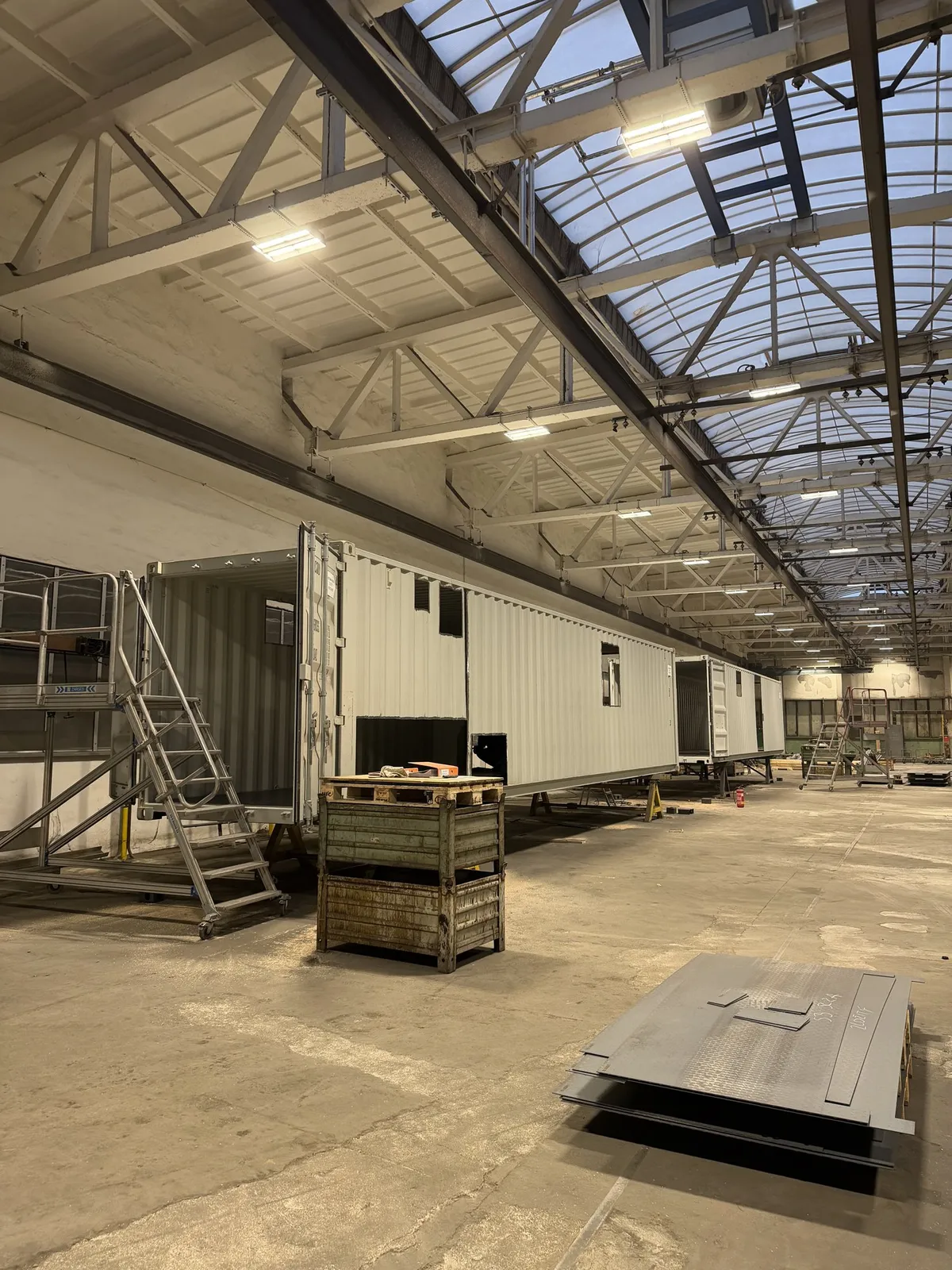
Sooted corridor after a burn Welding in the factory Black module in the production hall Diamond-plate steel floor Fabricator inside the module Corridor during production Interior equipment Corridor, second view Interior fabrication Work platform in the hall Training-room interior Floor detail Interior before fit-out Interior during production
Delivery
How it got there and got accepted
Both units passed a two-day factory acceptance test at Bánovce with the customer's engineering and production leads present, a rework list was agreed and closed, and the units shipped on booked special transport. A three-hour crane waiting charge on one delivery was raised, evidenced and settled at the agreed hourly rate.
Outcome
What was delivered, what it proved
Two prototypes delivered and accepted, a rework list closed, a revised commercial structure agreed, and serial volumes set for 2027 with minimum order quantities per type. The programme also produced the internal policy that prototype work is never priced as if it were serial work.
Send us the specification. A drawing, a tender annex, or three sentences.
You will get a written review of it inside a week, whether or not you buy anything.
Where to go next
Related families
Related sectors
Related case studies