
Defence
- 200+
- modules delivered
- €16 M
- class framework
- 3
- phases to date
- 10
- working days to erect a 40-module set
- 160
- modules accepted in one quarter
The brief
A Central European ministry of defence needed accommodation, corridor and sanitary modules delivered to multiple garrisons under a multi-year framework, connected into working sets on arrival, and accepted formally at each site. Deliveries had to be scheduled around site access, crane availability, national truck driving bans and the ministry's own acceptance timetable. Manufacturing ran in parallel with delivery across three contract phases.
What was built
Scope, line by line
- Accommodation modules with a large window and external steel doors
- Corridor modules carrying the fire-protected access route between cells
- Men's sanitary modules with showers and WC
- Women's sanitary modules with showers and WC
- Electric wall convectors, one per cell
- Wall-mounted air-conditioning units, one per cell
- Double sockets, two per cell
- Storage modules under a later call-off
- Site platforms, electrical connections, and SK/EN installation manuals
Engineering decisions
What cost money, changed the design, or both
- 01
Sets, not units.
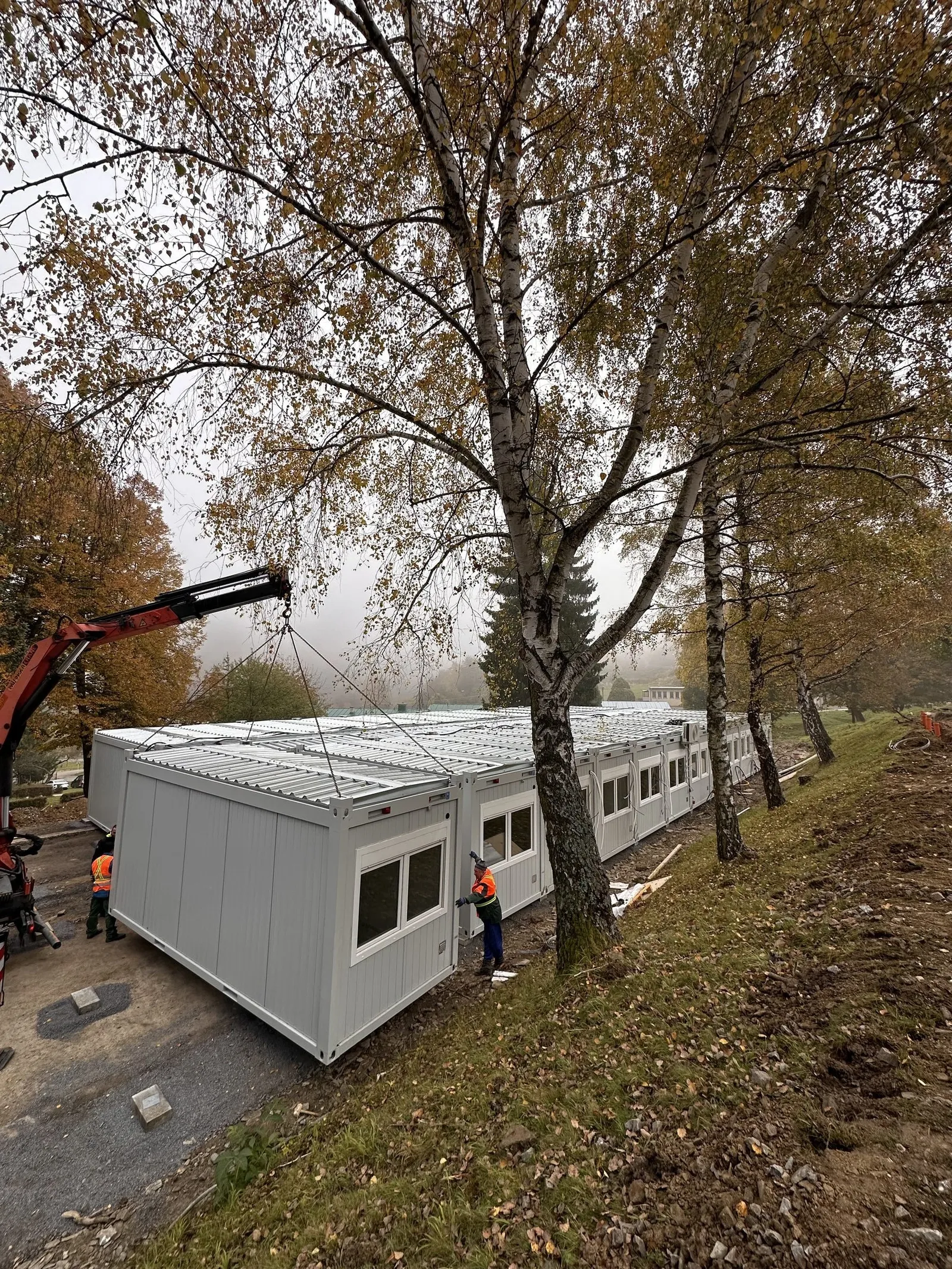
Modules were designed to be interconnected into 40-unit sets rather than delivered as standalone boxes. That drove the corridor module design, the connection kits, the levelling system and the site sequence, and it is why two 40-unit sets could be erected in roughly ten working days with a forklift of 5 t or more, a hydraulic-arm truck, two riggers, optical levelling and long spirit levels.
- 02
Acceptance details settled early, because they are always the same ones.
The recurring acceptance points across phases were PVC floor end trim, the socket and switch combination at the entry door, rubber door stops and wall retention, and the 1,800 × 1,200 tilt-and-turn window at U ≤ 1.1 W/m²K. Those four items now appear in the specification at quotation stage rather than in a defect list at handover.
- 03
Delivery rate designed backwards from the site, not from the factory.
Unloading was planned at 15 trucks a day rising to 20, 30 to 40 modules a day, with a crane booked from 06:00 and a hydraulic-arm truck as fallback. One site had grass hardstanding with a bogging risk in rain, which was surveyed before the first truck moved. Monday starts were set at 11:00-12:00 to clear the national truck driving ban.
- 04
Defect closure was made part of assembly, not a separate visit.
Where a defect list arrived after delivery, damaged door leaves, corroded keys on a run of corridor modules, one roof flashing fitted inverted, the fix was carried out during assembly into sets rather than as a return visit. Faster for the customer, cheaper for everyone.
Gallery
Photographs of the actual work
Exterior of an assembled set Corridor module under construction Crane lift on site Ceiling light and detector Connected set, exterior
Delivery
How it got there and got accepted
Three phases to date, each manufactured in parallel with delivery and accepted formally at the receiving site.
| Phase | Scope |
|---|---|
| Phase 1 | 80 modules, delivered and assembled as two connected 40-unit sets |
| Phase 2 | 160 modules across two garrisons: 88 accommodation with large window and external steel doors, 28 men's sanitary, 12 women's sanitary, plus 144 convectors, 88 climate units and 176 double sockets |
| Phase 3 | Storage modules, first call-off of 12 |
Outcome
What was delivered, what it proved
More than 200 modules delivered against a live framework running to 2028, with formal acceptance completed at each site. The programme is the reference base behind every other defence enquiry Tanax answers.
Send us the specification. A drawing, a tender annex, or three sentences.
You will get a written review of it inside a week, whether or not you buy anything.
Where to go next
Related families
Related sectors
Related case studies